
From the Editor
Editor-in-chief of the journal «New psychological research» T. D. Martsinkovskaya, Moscow, 22 December 2025
Dear colleagues, this is the fourth and final issue of our journal for this year.
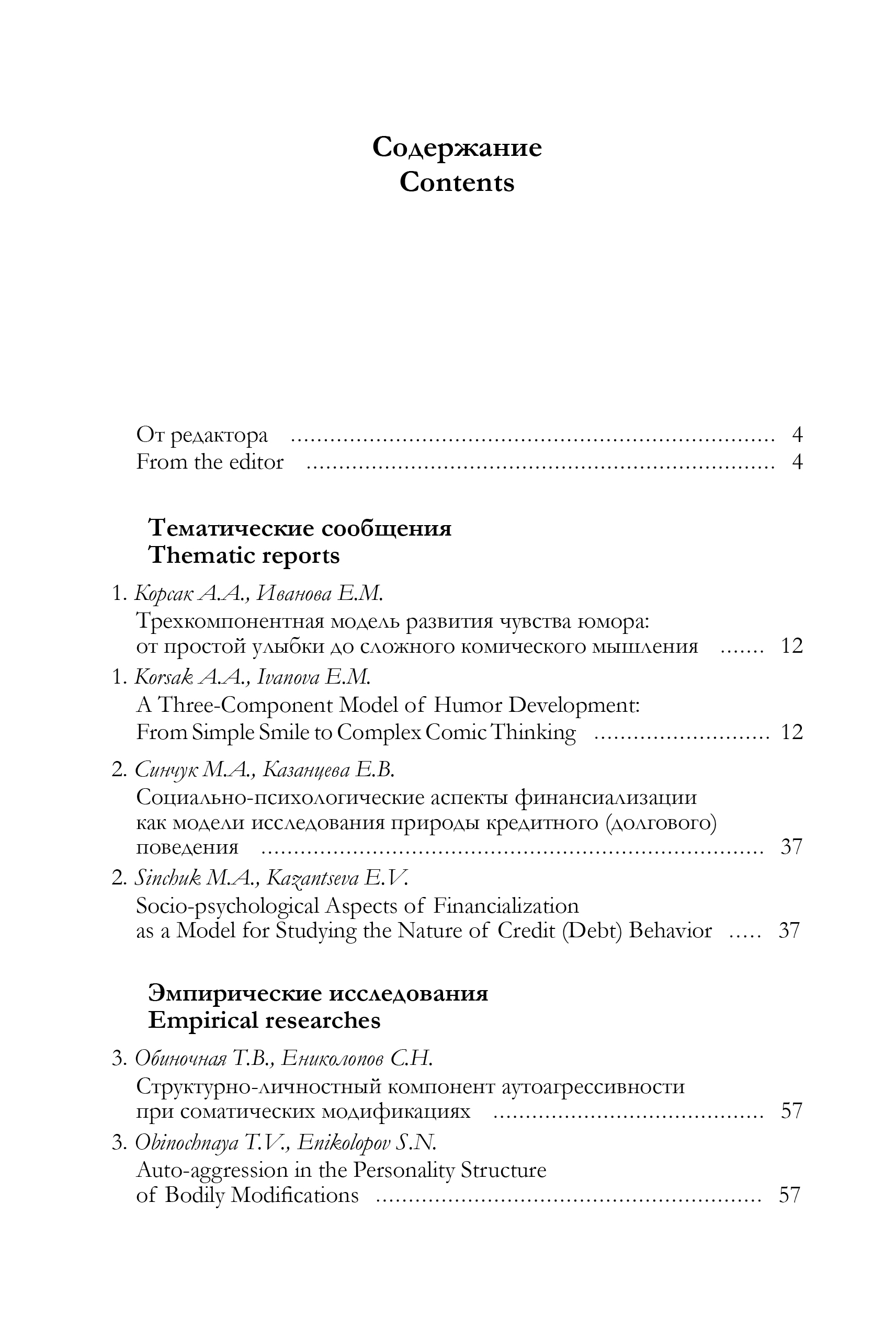
It opens with the article by A.A. Korsak and E.M. Ivanova “A three-component model of sense of humor development: from a simple smile to complex comic thinking”. This analytical article presents a narrative overview of the development of a sense of humor in children. The obtained materials enabled the authors to create a new periodization of the stages of sense of humor development, based on a cultural-historical approach and the idea of sensitive periods.
The article by M.A. Sinchuk and E.V. Kazantseva “Socio-psychological aspects of financialization as a model for studying the nature of credit (debt) behavior” examines the highly relevant question of developing economic literacy and appropriate economic behavior. The authors identified the main approaches to describing the levels of financialization's penetration into everyday life and demonstrated that credit behavior is becoming an important condition for human socialization in the modern world.
T.V. Obinochnaya and S.N. Enikolopov in the article “Autoaggression in the personality structure of bodily modifications” explored personality traits that reveal the link between somatic modifications such as tattoos and piercings and self-harming and suicidal behavior. The findings revealed that components of self-aggression and emotional dependence can be identified in the personality structure of persons with self-harming and suicidal behavior. This allowed the authors to consider body modifications as a risk factor for the development of self-aggressive behavior.
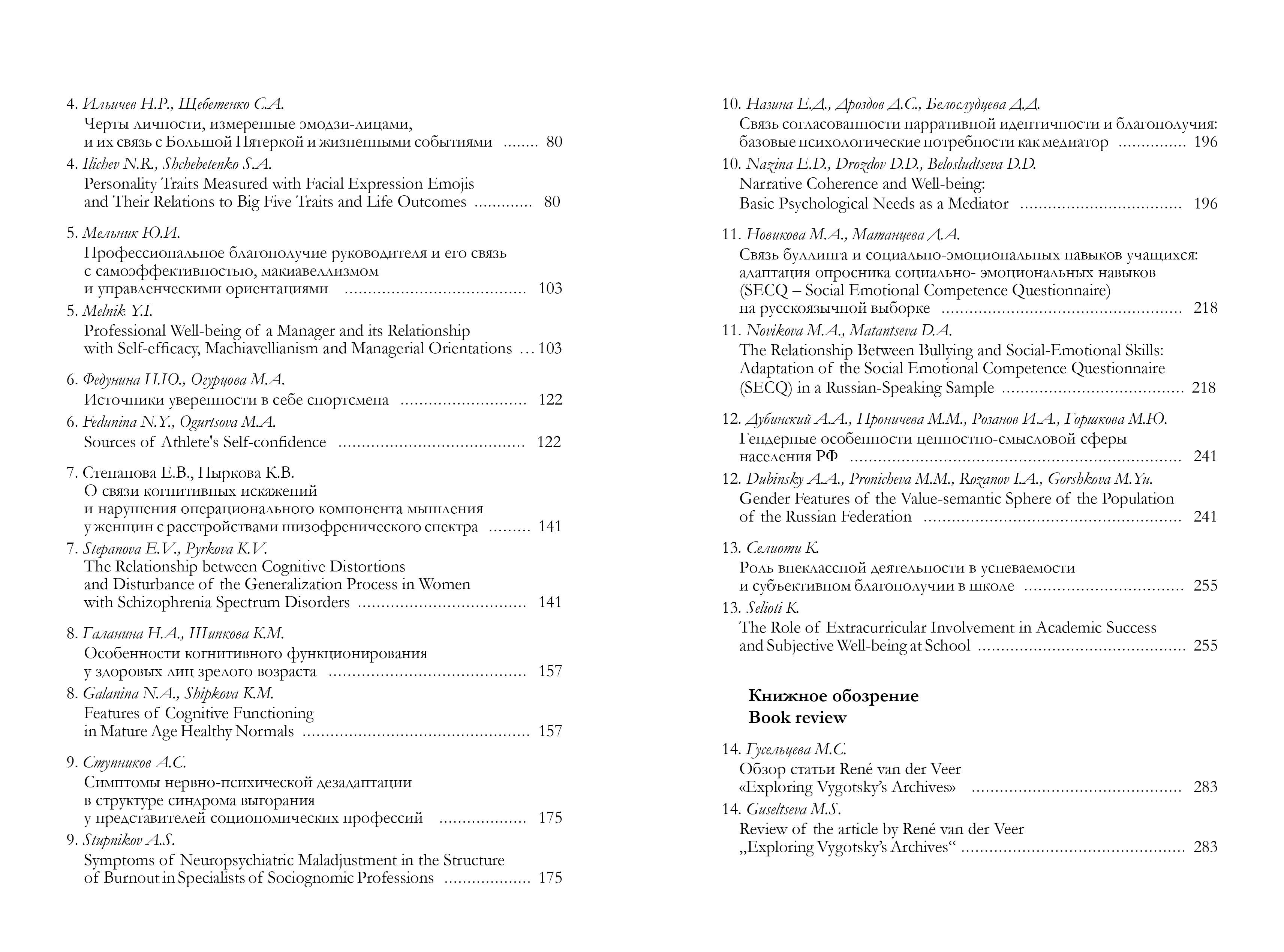
In the article by N.R. Ilychev and S.A. Shchebetenko “Personality traits measured with facial expression emojis and their relations to big five traits and life outcomes” was examined the relationship between emoji and personality traits. The authors believe this relationship could form the basis for new personality diagnostic methods. The authors' findings demonstrated the prognostic value of emoji and the potential for creating a questionnaire for measuring personality traits.
Y.I. Melnik in the article “Professional well-being of a manager and its relationship with self-efficacy, machiavellianism and managerial orientations” presents the results of the study examining self-efficacy, Machiavellianism, and management orientations in relation to varying levels of professional well-being in managers. The findings demonstrate that professional well-being, self-efficacy and Machiavellianism function as two separate, relatively independent factors.
N.Y. Fedunina and M.A. Ogurtsova in the article “Sources of athlete self-vonfidence” reveal the complexity of the structure of self-confidence, confirming the need for an integrated approach in the psychological support of athletes. Increasing athletes' efficiency should be based on an analysis of their individual self-confidence profile.
In the article by E.V. Stepanova and K.V. Pyrkova “The relationship between cognitive distortions and disturbance of the generalization process in women with schizophrenia spectrum disorders” were presented the results of a study examining the relationship between the generalization process and cognitive distortions. The obtained data revealed that women with schizophrenia spectrum disorders show cognitive distortions such as personalization, mindreading, and maximalism. These findings allowed authors to observe generalization distortions from a different perspective, expanding their impact on communication and social cognition.
N.A. Galanina and K.M. Shipkova in the article “Features of cognitive functioning in mature age healthy normals“ present the results of a study of cognitive characteristics intended for the development of intervention programs. The findings confirm the heterogeneity of the cognitive aging process and allow for the development of an adequate cognitive prevention program for memory deficits in mature persons and specific neurocognitive prevention programs for men and women.
In the article by A.S. Stupnikov “Symptoms of neuropsychiatric maladjustment in the structure of burnout in specialists of sociognomic professions” were presents the results of a comprehensive study of burnout syndrome. The data obtained in the study demonstrated that burnout syndrome includes emotional exhaustion, depersonalization, and a reduction in professionalism, as well as a range of somatic, vegetative and neurotic symptoms. These data convincingly demonstrate the complex nature of this condition.
In the work by E.D. Nazina, D.S. Drozdov, and D.D. Belosludtsova “Narrative coherence and well-being: basic psychological needs as a mediator” was conducted the study examining the relationship between narrative coherence and psychological well-being. The results reveal possible mechanisms for this relationship and present a new mediator of the relationship between narrative coherence and psychological well-being: frustration of the need for competence.
In the article by M.A. Novikova and D.A. Matantseva “The Relationship between bullying and Students' Social-Emotional Skills: adaptation of the Social Emotional Competence Questionnaire (SECQ) in a Russian-Speaking Sample” was presented an adapted Russian-language version of the Social Emotional Competence Questionnaire (SECQ). This questionnaire demonstrated high psychometric properties and was consistent with the factor structure of the original version. Obtained data showed a statistically significant negative relationship between the level of SECQ development and the risk of bullying involvement. Overall, the authors emphasize that developing students' social-emotional skills can be considered a significant resource for bullying prevention.
In the article by A.A. Dubinsky, M.M. Pronicheva, I.A. Rozanov, and M.Yu. Gorshkova “Gender features of the value-semantic sphere of the population of the Russian Federation” was shown that men and women's value choices are virtually identical. However, despite the similarity in value orientations between men and women, significant psychological differences are observed in manifestations of aggression, emotional-behavioral aspects, and social attitudes, which are important to consider when developing social and psychological programs.
K. Selioti in the article “The role of extracurricular involvement in academic success and subjective well-being at school” demonstrates that academic performance and subjective well-being at school are positively correlated regardless of students' participation in extracurricular activities.
M.S. Guseltseva in the review of René van der Veer's article, “Exploring Vygotsky's Archives”, was shown that, according to R. van der Veer, a full understanding of L.S. Vygotsky’s intellectual heritage requires studying not only his published works but also his notebooks, rough notes, unedited manuscripts, and correspondence. To support his argument, R. van der Veer presents his own analysis of several such notes and fragments of scholarly correspondence. R. van der Veer concludes that there is a potential for systematic collection of all correspondence stored in various public and private archives.
In conclusion, I wish everyone a Happy New Year, success, optimism, good health, and, of course, renewed productivity and new wonderful articles!

Received: 22nd december 2025
Published: 22nd december 2025