
From the Editor
Editor-in-chief of the journal «New psychological research» T. D. Martsinkovskaya, Moscow, 21 June 2026
Dear colleagues, I present the second issue of the 2026 year.
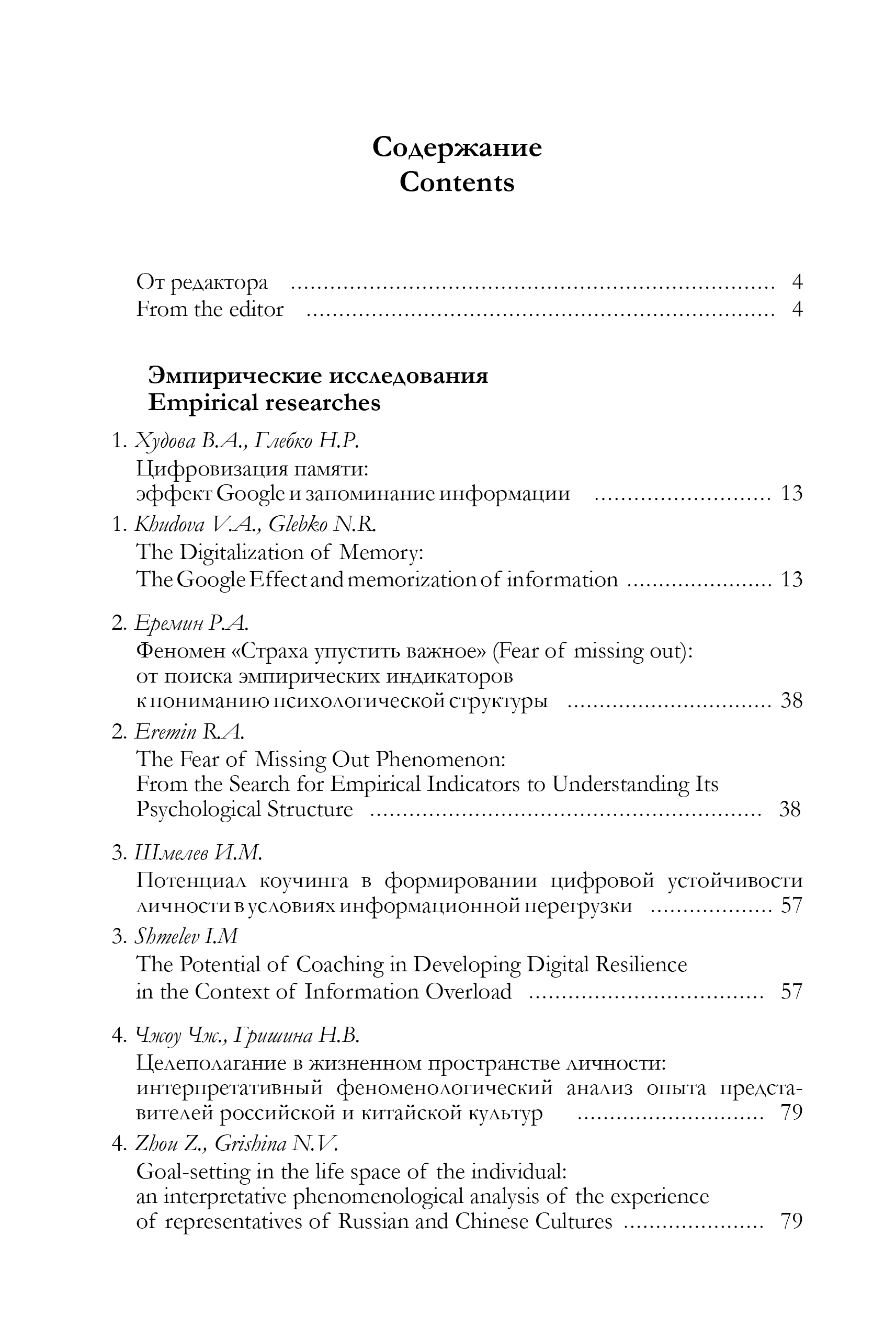
It opens with the article by V.A. Khudova and N.R. Glebko “The Digitalization of Memory: The Google Effect and memorization of information” which presents research (replicating the work of Storm and Stone) about the effect of enriched memorization when preserving the original information. The results showed that in the reliable condition, there was a tendency for better word recall when preserving the original information, while in the unreliable condition, higher recall rates were observed in trials without preserving, which may indicate increased reliance on one's own memory while distrusting external media.
The study of information search and online behavior is discussed in the article by R.A. Eremin “The Fear of Missing Out Phenomenon: From the Search for Empirical Indicators to Understanding Its Psychological Structure”. The focus of this paper is the problem of the conceptual blurring of this phenomenon. The author substantiated the proposal to move a stable intrapersonal trait, designated within the model as a trait-SUV, beyond the construct of the SUV into the category of predictors. The construct of digital resilience itself is viewed as the interaction of two components – cognitive-affective and cognitive-motivational – with the social nature of the core of digital resilience serving as an additional filter.
In I.M. Shmelev's article, “The Potential of Coaching in Developing Digital Resilience in the Context of Information Overload”, it is demonstrated that developing of digital resilience in the context of information overload becomes critically important. The author created a framework for a coaching model for digital resilience. Moreover, coaching serves not only as a practice-oriented technology for compensating the negative effects of information overload, but also as an innovative, personalized, and strategic tool for developing adaptive and holistic personal functioning.
In the article by Z. Zhou and N.V. Grishina “Goal-setting in the life space of the individual: an interpretative phenomenological analysis of the experience of representatives of Russian and Chinese Cultures” are presented the results of a study conducted within the framework of interpretive phenomenological analysis. The theoretical basis of the study was formed on the basis of K. Lewin's field theory about the individual's life space and modern concepts of goals as a dynamic system. The results of the study demonstrated that human goals function as an integrated dynamic system, organized within the individual's life space and possessing a contextually determined nature. The authors identified three key structural characteristics of the goal system: tension, hierarchy, and consistency, reflecting the degree of psychological involvement of the individual, the subjective significance of goals, and their temporal organization. The obtained results allow to consider the individual's goal system as a form of organization of person’s interaction with life situations, embodying the dynamic unity of the subject and their life space.
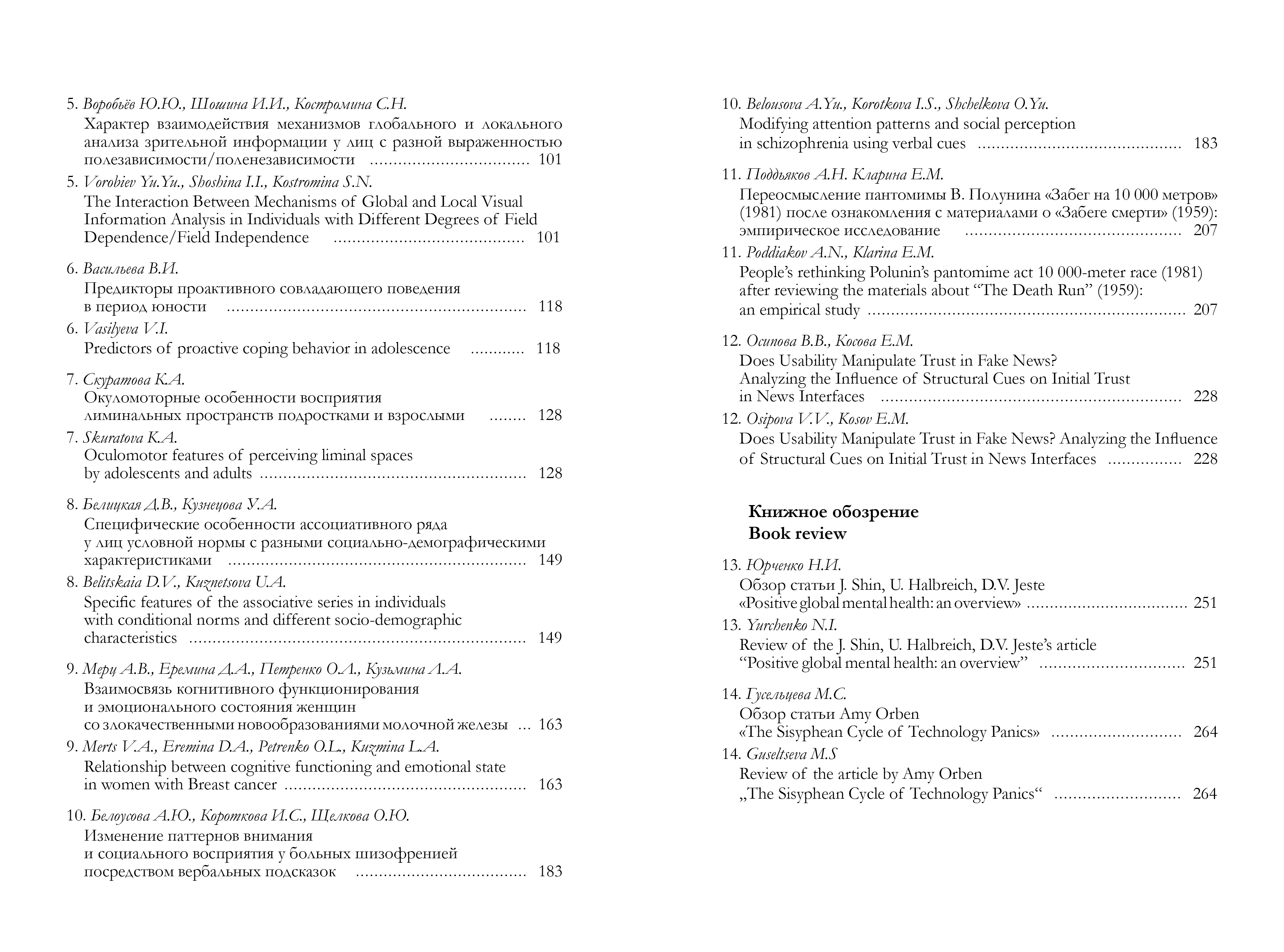
The article by Yu.Yu. Vorobiev, I.I. Shoshina, and S.N. Kostromina “The Interaction between mechanisms of Global and Local Visual Information Analysis in Individuals with Different Degrees of Field Dependence/Field Independence” presents the results of a study examining the neurophysiological correlates of this phenomenon. The study examined the nature of the interaction between the mechanisms of global and local analysis of visual information in individuals with varying degrees of field dependence and field independence. The findings demonstrate that the degree of field dependence/field independence is associated with the functioning of the neural networks supporting the mechanisms of global and local information analysis. The authors view these results as evidence of a more pronounced activity of the global information analysis mechanism in individuals with a fixed field-dependent cognitive style.
In the article by V.I. Vasilyeva “Predictors of proactive coping behavior in adolescence” examines the predictors of proactive coping behavior. The findings demonstrate the complex determination of proactive coping, with time perspective playing a key role as the ability to predict the future in constructing appropriate behavior.
K.A. Skuratova's article “Oculomotor features of perceiving liminal spaces by adolescents and adults” is devoted to the investigation of the important and understudied subject of perceiving liminal spaces and the relationship between eye movements and emotional assessments. The findings revealed that adolescents were more likely than adults to experience high levels of anxiety. Furthermore, viewing duration and the number of fixations were positively correlated with anxiety and the desire to be in the space. The author concludes that adolescents exhibit an ambivalent reaction to liminal spaces: simultaneously more anxious and exploratory and inquisitive, which is reflected in their oculomotor behavior.
D.V. Belitskaia and U.A. Kuznetsova's article “Specific features of the associative series in individuals with conditional norms and different socio-demographic characteristics” is devoted to the analysis of the quantitative and qualitative indicators of the associative series in respondents of different ages and genders. The obtained data revealed age- and gender-specific differences in associative processes, with higher education contributing to the preservation of cognitive functions. These findings are important for diagnosing and developing cognitive support programs for adults and the elderly.
The article by V.A. Merts, D.A. Eremina, O.L. Petrenko, and L.A. Kuzmina “Relationship between cognitive functioning and emotional state in women with Breast cancer” examines cognitive and emotional indicators in women with breast cancer before systemic treatment. The obtained data support the need for a comprehensive approach to analyzing patients' mental states before systemic therapy and the importance of further longitudinal clinical studies.
In the work by A.Yu. Belousova, I.S. Korotkova, and O.Yu. Shchelkova “Modifying attention patterns and social perception in schizophrenia using verbal cues” is analyzed strategies for visual scanning and interpreting the content of social narratives. Cognitive distortions can be markers of changes in mentalization during intervention. Research has demonstrated the potential of using targeted questions to modify implicit mentalization processes in patients with schizophrenia.
The article by A.N. Poddiakov and E.M. Klarina “People’s rethinking Polunin’s pantomime act 10 000-meter race (1981) after reviewing the materials about “The Death Run” (1959): an empirical study” presents the results of a currently rare emergent study. It compared data on the content of responses and its emotional content before and after presenting two scenes with pantomime and a real marathon. The results revealed a variety of assessments of the pantomime and, most importantly, a rethinking of the scenes and analysis of the connections between art and life, sport and duty, and the meaning of life in various circumstances.
The work by V.V. Osipova and E.M. Kosov “Does Usability Manipulate Trust in Fake News? Analyzing the Influence of Structural Cues on Initial Trust in News Interfaces” aims to study the impact of structural cues on user trust in web news interfaces. The results showed that the presence of structural cues, as well as their type and placement in the interface, significantly influenced trust in news interfaces, with interfaces with cues rated higher than those without it. Trust also correlated with the perceived familiarity of the interface.
N.I. Yurchenko's paper presents a review of the article “Positive global mental health: an overview” by J. Shin, U. Halbreich, and D.V. Jeste. The authors of the article, “Positive Global Mental Health”, emphasize the need to focus not on responding to problems but on prevention, identifying and developing a person's internal resources. Strong social connections and the availability of support from others are equally important. Scientific evidence convincingly demonstrates that positive psychosocial factors have a significant impact on health. Current data on the global prevalence of loneliness, social isolation, suicidal behavior, and substance abuse demonstrate the urgent need to develop effective support measures, both at the individual and societal levels. These measures should be aimed at improving the quality of life and psychological well-being of the entire population, including people with mental disorders.
M.S. Guseltseva in her work provides a review of Amy Orben's highly relevant article, “The Sisyphean Cycle of Technology Panics”. Amy Orben analyzes the phenomenon of recurring public panics arising around new technologies, particularly digital ones. The article argues that this is a natural phenomenon that always accompanies the technological development of society, known as the “Sisyphean cycle”. However, the lack of theoretical continuity makes psychological research on technology fragmented and slows the development of adequate policies capable of directing technological change for the benefit of society. Orben identified four stages of the “Sisyphean cycle” of technology panics and demonstrated that the “Sisyphean cycle” of technology panics hinders the constructive role of psychology in managing technological change. Therefore, a psychological discipline is needed that can generalize all technology panics and analyze the Sisyphean cycle they trigger.
In conclusion, I wish both our authors and readers a wonderful summer and strength for new articles!
Received: 21st june 2026
Published: 21st june 2026