
From the Editor
Editor-in-chief of the journal «New psychological research» T. D. Martsinkovskaya, Moscow, 27 March 2026
Dear colleagues, I present the first issue of 2026. This issue is theatrical one. In consultation with Professor Dmitry Alekseevich Leontiev, we decided to dedicate it to new psychological methods. So it includes questionnaires designed for use in various fields of psychological science.
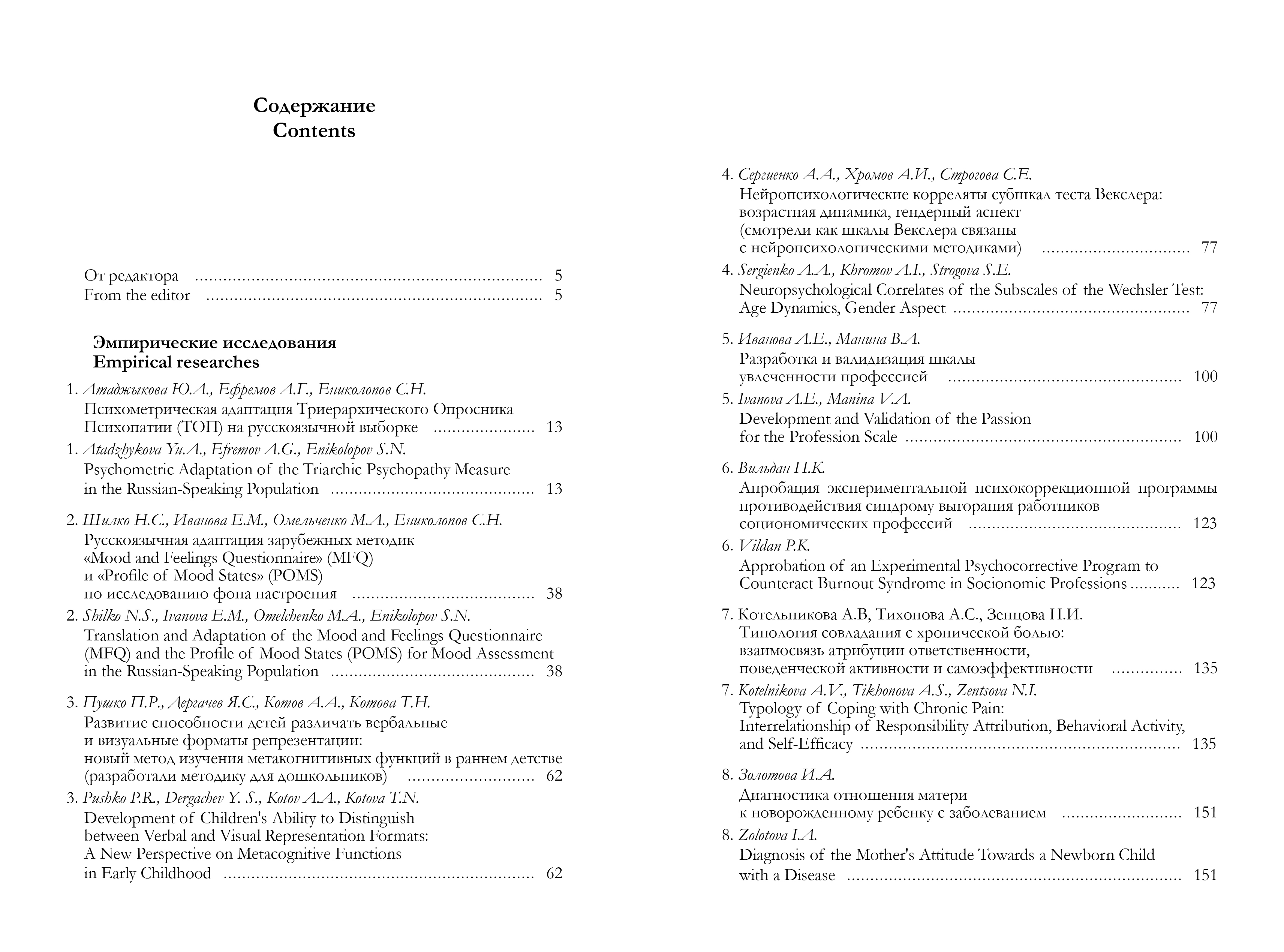
The issue opens with an article by Yu.A. Atadzhykova, A.G. Efremov, and S.N. Enikolopov "Psychometric adaptation of the Triarchic Psychopathy Measure on the Russian-speaking population." The article emphasizes that Russian-language psychology currently lacks instruments for measuring psychopathy. The trierarchical model of psychopathy allows for the study of psychopathy as a dimensional construct, and the Trierarchical Psychopathy Questionnaire (TIPS), developed on its basis, demonstrates high potential for theoretical and practical research of psychopathy, while remaining a compact and inexpensive instrument. The authors emphasize that the TOP in its full Russian-language version is a satisfactory method for measuring psychopathy.
The article by N.S. Shilko, E.M. Ivanova, M.A. Omelchenko, and S.N. Enikolopov, "Russian-Language Adaptation of the Mood and Feelings Questionnaire (MFQ) and the Profile of Mood States (POMS) for Mood Assessment" emphasizes that effective diagnosis of affective disorders requires reliable methods sensitive to various components of emotional state. This is precisely what for the authors' adapted methods are designed. Both methods, as the authors highlight, have demonstrated good psychometric characteristics and can be recommended for the clinical diagnosis of affective disorders and the assessment of emotional state dynamics during therapy.
The article by P.R. Pushko, Ya.S. Dergachev, A.A. Kotov, and T.N. Kotova "Development of children's ability to distinguish between verbal and visual formats of representation: a new method for studying metacognitive functions in early childhood," presents the results of a study examining a new type of representation in children, their ability to distinguish between verbal and visual representations. To analyze this ability, the authors developed a method that demonstrated age-specific boundaries in the development of the ability to distinguish between the two representational formats.
In their article, A.A. Sergienko, A.I. Khromov, and S.E. Strogova, "Neuropsychological correlates of the Wechsler test subscales: age dynamics and gender aspects", demonstrate the importance of developing new diagnostic tools for assessing the mental development of children and adolescents that would overcome the outdated standards of currently used instruments. The article presents an analysis of the neuropsychological correlates of the Wechsler Test subscales (children's version). As a result of the work, gender-nonspecific neuropsychological correlates of Wechsler subtests were identified, the presence of which does not depend on gender, and a number of gender-specific correlates, the contribution of which to the success of a particular subtest is determined by the gender of the subjects.
The article by A.I. Ivanova and V.A. Manina, "Development and validation of a profession engagement scale", is devoted to the development and validation of the "Profession Engagement" scale for university students. The authors identified three interrelated components that served as indicators of the developed scale: emotional identification with the profession, aspiration for development, and awareness of the social and personal significance of the future profession. The results demonstrate the potential of the questionnaire for research practice and prospects for its further upgrading.
The article by P.K. Vildan "Approbation of an experimental psychocorrective program to counteract burnout syndrome in socionomic professions" presents the results of testing the author's psychocorrectional program to combat burnout syndrome in workers in socionomic professions. The program's effectiveness is demonstrated during its testing.
The article by A.V. Kotelnikova, A.S. Tikhonova, and N.I. Zentsova "Typology of coping with chronic pain: interrelationship of responsibility attribution, behavioral activity, and self-efficacy” demonstrates the importance of combining attribution of responsibility and personal activity in analyzing the typology of coping with illness. Four coping patterns based on a combination of activity/passivity and internality/externality are identified. It is shown that the proposed typology have prognostic value for clinical practice.
I.A. Zolotova's article " Diagnosis of the mother's attitude towards a newborn child with a disease” presents an adapted method aimed at assessing the relationship between a mother's attitude toward her newborn and the characteristics of a woman's psychoemotional state. It is demonstrated that this projective technique not only serves a diagnostic function but also has psychotherapeutic implications.
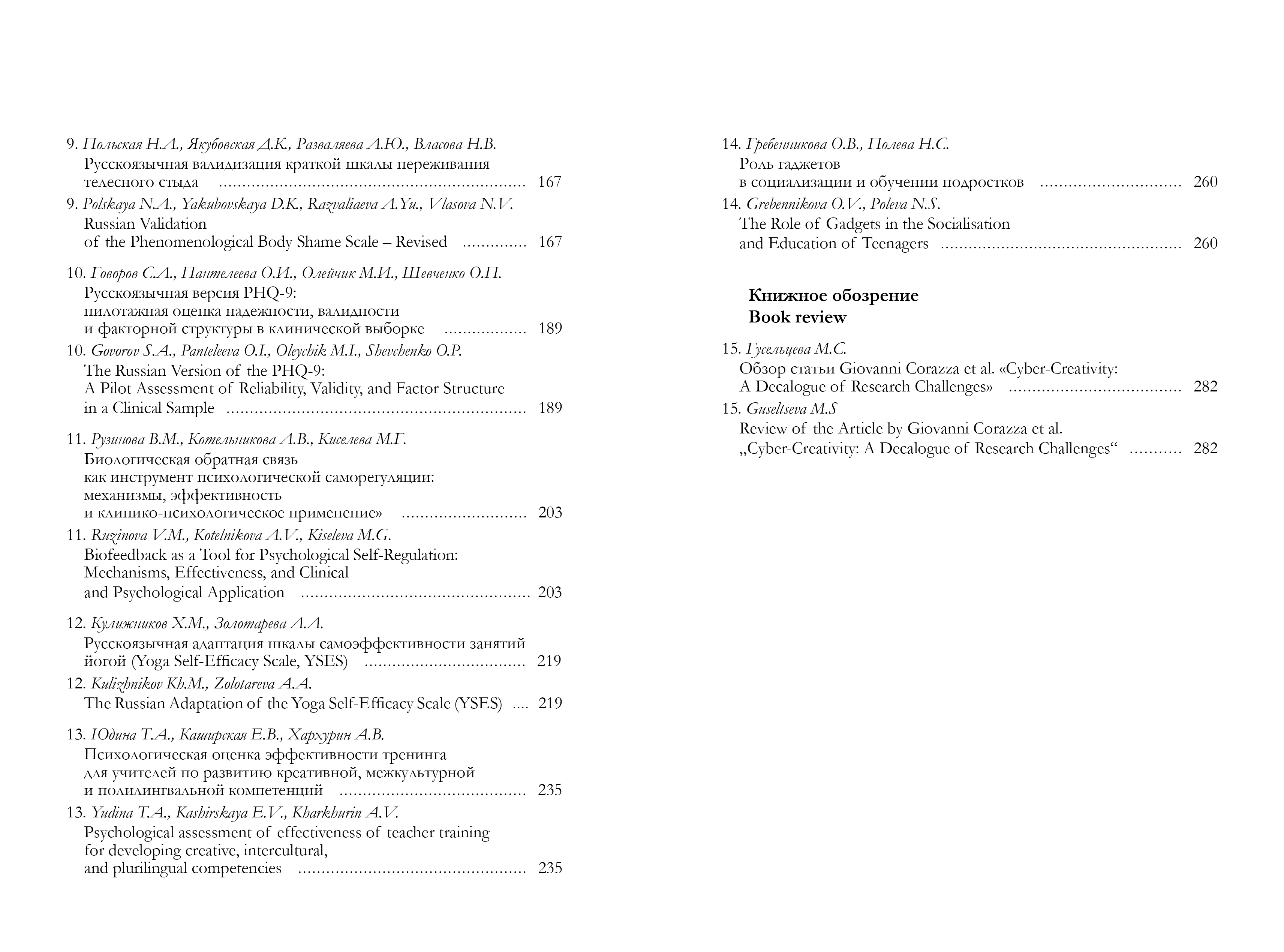
In the article by N.A. Polskaya, D.K. Yakubovskaya, A.Yu. Razvaliaeva and N.V. Vlasova" Russian validation of the Phenomenological Body Shame Scale” was conducted a psychometric validation of the brief body shame scale using a Russian-speaking female sample of adolescents and young adults. The checking demonstrated that the brief body shame scale has good psychometric properties and can be used both in research and in psychological counseling.
The article by S.A. Govorov, O.I. Panteleeva, M.I. Oleychik, and O.P. Shevchenko, "Russian-language version of the PHQ-9: a pilot assessment of reliability, validity, and factor structure in a clinical sample" presents the results of a study of the psychometric properties of the Russian-language version of the PHQ-9 questionnaire. The results revealed good internal reliability, demonstrating that the Russian-language version of the PHQ-9 is a persistent and valid tool for screening for depression in patients with nonpsychotic disorders.
The article by V.M. Ruzinova, A.V. Kotelnikova, and M.G. Kiseleva " Biofeedback as a tool for psychological self-regulation: mechanisms, effectiveness and clinical and psychological application" presents the results of a study on the clinical and psychological application of biofeedback for developing psychological self-regulation skills in various forms of maladjustment. It is demonstrated that biofeedback is a highly effective tool aimed at developing psychological self-regulation skills, reducing maladjustment, and improving patients' quality of life.
The aim of Rh.M. Kulizhnikov and A.A. Zolotareva's study "Russian-Language adaptation of the Yoga Self-Efficacy Scale" was to adapt the Russian-language version of the yoga self-efficacy scale. The results obtained in the study demonstrated that the Russian-language version of the yoga self-efficacy scale is a reliable and valid instrument for measuring individuals' confidence in their ability to effectively practice yoga.
The article by T.A. Yudina, E.V. Kashirskaya, and A.V. Kharkhurin "Psychological assessment of the effectiveness of a teacher training for developing students' creative, intercultural, and multilingual competencies" describes a program for psychologically assessing the effectiveness of a teacher training program. This program uses a pre-test/post-test experimental design, incorporating both quantitative and qualitative instruments for measuring competencies in both teachers and students. It promotes the development of a creative self and pedagogical self-efficacy and supports the subjective well-being of school teachers.
The article by O.V. Grebennikova and N.S. Poleva, "The role of gadgets in the socialization and education of adolescents," presents the results of a theoretical and empirical study. Based on a summary and systematization of meta-analyses, the nonlinear nature of the relationship between gadget use and indicators of adolescent socio-psychological development and well-being is demonstrated. The ambivalent role of gadgets in the learning and socialization of adolescents is demonstrated.
M.S. Guseltseva presented a review of the article by Giovanni Corazza et al., “Cyber-Creativity: A Decalogue of Research Challenges". The article examines the phenomenon of cybercreativity and models of the alternative future. The authors identified a decalogue of research problems and concluded that a more thorough understanding of the prospects for the development of AI and its alignment with human values in the field of creative activity is needed.
Congratulation with spring and wishing good moods and successful work!

Received: 27th march 2026
Published: 27th march 2026